

You hurt your back.
You do what you’re supposed to do.
You call. You schedule. You wait.
Three weeks later, you sit in a cold chair under fluorescent lights,
flipping through magazines from 2017.
After you’re done filling out a stack of paperwork,
They call your name.
You walk into a sterile room.
And then you wait again.
The doctor enters.
Five minutes.
He barely looks at you.
He’s typing. Clicking.
Staring into the glow of a system that does not see you.
He gives you a script.
A referral to a specialist.
He disappears.
A month later, a bill arrives that makes no sense.
You owe $387.64.
For what?
You don’t even know.
You end up confused.
Uncared for.
A line item in a spreadsheet.
You wonder,
“Why doesn’t he care?”
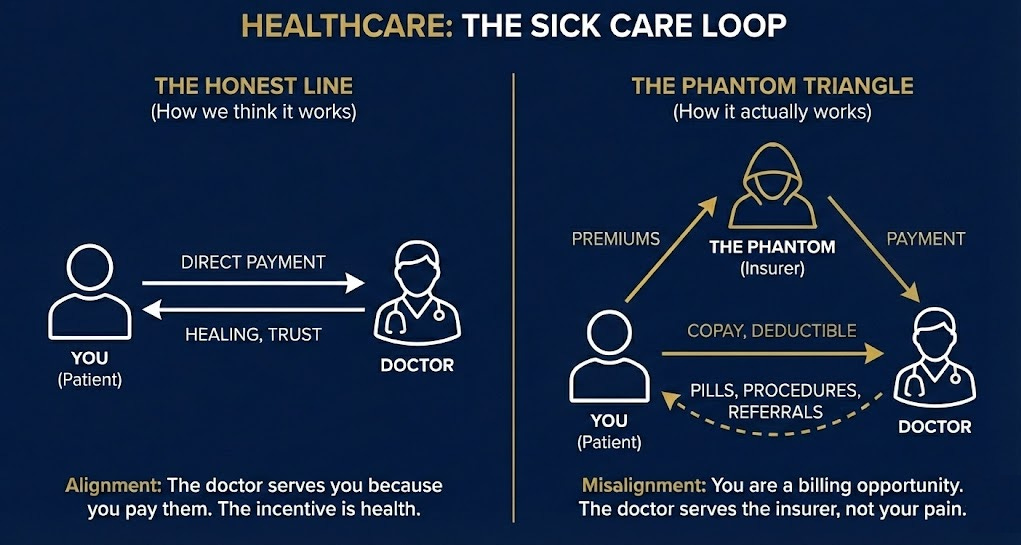
In the beginning, the line was clean.
You got hurt.
You paid.
The doctor helped.
The incentive was health.
If he failed, he felt it.
If he helped, he earned your trust.
That was the Straight Line.
Then we broke it.
We inserted a third party.
You → The Insurer → The Doctor
And just like that, the customer changed.
You don’t pay the doctor.
The insurer does.
So who gets served?
Not you.
The Phantom Customer sits at the top,
holding the purse strings.
The insurer isn’t incentivized to care about your pain.
They care about their profits.
They’re want to pay out as little as possible.
So they build a wall of bureaucracy.
Denials. Prior authorizations. "Not medically necessary."
Consequently, the doctor is forced to spend more and more time doing admin work.
Click the right box.
Use the right code.
Justify the procedure against an algorithm designed to say “no.”
That’s why he barely looks at you.
He is typing to build a legal defense for the invoice.
If he doesn’t, he doesn’t get paid.
And your claim gets denied.
And since the doctor is squeezed on price and payouts,
He has to make up for it with volume
"See more patients."
"Order more tests."
So, you get a pill.
A procedure.
A new specialist.
A quick spin through the machine.
Healthcare workers don’t want this either.
They didn’t sign up for codes and quotas.
They signed up to help people.
But the incentives changed.
Prevention doesn’t bill.
Nutrition doesn’t code.
Listening doesn’t scale.
More and more of their time is spent fighting the insurance companies.
And the clinics can’t keep up.
The small-town doctor can’t afford the admin squad,
the billing experts, the appeals specialists,
the machinery required to survive the Phantom.
So he sells.
He retires.
He burns out.
And the giants move in.
The hospitals merge.
Private equity circles like vultures.
Until we’re left with colossal
Mega-Hospitals on one side.
Mega-Insurers on the other.
And crushed between them…
Healthcare workers.
And you.
Back in the waiting room.
Still hurting.
Still waiting.